Showing posts with label process. Show all posts

Thursday, April 17, 2014

New Direction

Hello everyone! Lately, I have found myself unable to write about what I am doing in the studio. A new series is in the process of being created, and I needed to avoid words for a while and focus on image only. For me, painting is a way to think, a way to sort out the ideas in my head. When I write, the words seem to confound the issues I am working out in paint. Trying to describe painting in words - is it a futile endeavor? Perhaps. Or maybe I just needed to turn inward in order for this new work to become something. In any case, I think I may be far enough into it now to feel comfortable sharing some of it.

It all began when I was getting ready to teach my online class "Intro to Abstract painting." I had created a series of exercises designed to help artists explore and experiment. I wanted to see if my exercises had any merit, and began doing them myself. I had done many of the exercises before, years ago, in a modified version. As I was testing my exercises, I stumbled upon an idea.


small watercolor & gouache studies - approx. 6 x 6 inches


What if that wonderful, lively quality of watercolor or gouache could be replicated on a larger scale using oil paint? I have always loved watercolor. My first experience with painting was watercolor painting. When I am feeling stuck in the studio, or when I want to go back to the basics, I always reach for watercolor. I decided to try working from some small watercolor sketches.

Whenever you take an idea or sketch and push it to a completed work of art, there is always a transformation. In this case, I found I was exaggerating the qualities I love in the water media. I was not aware of this. It just happened.

"What Was Found." Oil on canvas, 20 x 20 inches. 
Above is the first one I finished. I have about five others in various stages of completion. I will be interested to hear what you think.

What do you see? Does this painting remind you of anything?

If you missed my online class, it is now available to take as a self study. Just click this link for more details.

Sunday, January 15, 2012

Painting and Reading

my palette.
(both photos on this post were taken by Elena Ray.)

It's super windy outside, making it easy to spend the day indoors painting. After an absence from the studio, sometimes the first couple of days back are, well, agonizing. It's as though I have forgotten how to paint. The hard part is staying with it, when things are like that. When you do, good things will happen. They will.

Robyn asked me to tell more about the book I am reading - The Lacuna. Written by Barbara Kingsolver. I am not the kind to go into too much detail about a book, but I will say this: If you don't find a copy of this book and read it, I am not sure we can continue to be friends. It is a delight. It is the sort of book one wants to savor, in the way you would a box of fine chocolate. Hide it in a safe place and take one bit out. Read it slowly, swallow it down. Then, spend the next 5 or 10 minutes thinking about how good it is. You fight the urge to sit down and devour it at once. Some may succumb to the overwhelming urge to do just that. Not I. I have been trying to make it last as long as possible. I do carry it around the house with me, so I can look at the cover. Take another divine little bit in. Like that. So, are you convinced yet?

Today, I got two disks with photos taken by Elena Ray of me yesterday. They sat on the table for a couple of hours. I am not the kind of person who usually likes pictures of myself. I admit, even though I know Elena is a great photographer, my own fear of what I might see kept me from putting the disks in the computer and taking a peek. FINALLY, I managed to do it. WOW! I am so happy with the photos. For the first time ever, I have pictures of myself painting. And quite a number of pictures of myself that I can actually look at without cringing. It's amazing. Elena, you are one talented photographer! My personal hero. And now I can put photos on the blog and website that are actually current. Yay!

Mixing paint.


Monday, August 18, 2008

Process


Here is another monotype from Saturday. I have talked about monotypes before, but I wonder if there are newcomers to my blog who may not know what a monotype is. For those of you who know, you can skip the next three paragraphs. A monotype is a cross between painting and printmaking. The artist (me, in this case) applies paint or ink directly onto a plexi glass plate. I use etching inks. Most often, I use a tool called a brayer to apply the ink. I will take a photo of one tomorrow and post it. You can also use a paintbrush or palette knife to apply the ink, if you wish. I usually draw right into the ink using various tools (my favorite being a McDonald's stir stick!). Once I have the background color the way I want, I like to put things on top of the background ink colors. Leaves, feathers, wire, and things I have cut out of cardboard or styrofoam. I save lots of cardboard from food boxes. My favorite kind of cardboard is cardboard with texture, like the insulating sleeves they give you with a cup of hot coffee at the coffee shop. Since I don't drink coffee, you will sometimes find me digging in trash cans, hopefully when no one is looking.

Once I have the plate looking the way I think I want it, I dampen a sheet of printmaking paper. I place the plexi glass plate on the bed of the printing press, place the damp paper over the top of it, and crank the wheel of the press. The press does just what you might think: it PRESSES the paper and the plate together with lots and lots of pressure. Basically, I am pressing the painting onto the paper. The press provides really wonderful textures that would be impossible to achieve with a brush on canvas. (I have tried to duplicate it, so I am confident in writing that.) The most exciting part of the process is when I lift the edge of the paper to see how it looks. Even though I have a good idea how most of it will turn out, there is always something unexpected that happens with the print when it goes through the press. It is so much fun! The pressure from the press will also create an impression in the paper of the edges of the objects I placed on top of the plate. This gives the print a really nice dimensional quality that I love.

The plate does not get carved into or permanently altered, so each print is one of a kind. Even if I were to print the same plate again without wiping it clean first, the second pressing is completely different from the first. So each print is unique. "Mono" means "one". A Monotype is an original, one-of-a-kind piece of art. I love creating them! Hopefully, if you didn't know what a monotype was before, I have helped shed some light on the subject for you.

With this particular print, I went back in after it was dry and added some pastel. I just wanted to bring the bird out a little more, and the "bird food" underneath it. I could have also used paint or ink to rework the monotype. This one is called "Pecking 2", and it measures 10 x 8 inches. The paper is larger than the print. I have given dimensions of the print only.

Tuesday, February 5, 2008

Completion escapes me


Another day, and I was SUPPOSED to be painting all day. Instead, I am circling the paintings, finished and unfinished, like a hungry wolf wanting a man's meat but not his proximity. Circling, circling... do I really think I will solve ANYTHING this way??? Sheesh. Finally, after way to much of this circling bit, I decided I needed to do something more casual, more playful, more fun. So I decided to begin a Valentine or two.

Of course, everything is about process for me. I can't just sit down with a blank card and some paint and make a Valentine. Noooooo, I am going to make cardboard hearts, stars, flowers and a crescent moon. I am going to apply gesso to some things. Then, I am going to circle THAT, too!!!! Thank goodness I had laundry to do, or I would have felt like my whole day was nothing more than some kind of endless merry-go-round.

I suppose I could give some excuses. Like the one where I say I just found out that my husband, who has already been gone for too long, isn't going to come home until the 11th. I had hoped he was coming home this Thursday. There's that excuse. I could also use the one where I tell you about how my sinuses are driving me NUTS here, and I am pretty sure there is something in the high desert I am allergic to. There's that excuse. I could also use the excuse that I am feeling a little bit of cabin fever, and I should attempt to go out in public very soon. I mean, I have a lot of excuses. Frankly speaking, what it boils down to is just plain, old procrastination. I have always had trouble completing paintings. I can have 20 paintings in progress, and fight to finish and sign my name to ONE. It's true. I have gotten a lot better about finishing, but it's obvious that I am not cured.

The painting at the top of this post is one of the paintings I have been circling. Oil on canvas, it's about 18 x 24" or so. I have reworked it now several times, and still I am not sure if it is done. I think it is. I think. Maybe. Or maybe the blue has to go. I can't think about it anymore!!!
Good night.

Tuesday, January 29, 2008

More thoughts on process

Hello, my dear blog readers. Today was not the best of days. I tried to paint all day, but it just wasn't there. I can't explain it, other than to say that I will be happy once tomorrow is here. Do I go to bed early, so that today is over sooner? No, because what if I fall asleep right away, wake up at 3 am, and toss for the rest of the dark hours? Unappealing. Not fun. I have to just hang in there, try not to break anything else, burn anything else, injure anything else, or shed any more tears. It was just one of those days. Let's talk about something else.

The day before yesterday, I finished a larger painting I have been bringing along. I really like how it turned out, especially the colors. What I find interesting, when working on a painting, is how if it is a painting I really like, it is so much harder to complete it. Because I don't want to "mess it up", it is almost as though I become paralyzed to the point where I can barely touch the brush to surface anymore! I remember the words of one of my college professors, who used to say, don't get too attached to any one part of a painting. You will work on that one part of the painting, while the rest of the painting suffers, or (worse, sometimes) you will work on the rest of the painting, not wanting to let go of the one, beloved spot. Then, when you step back and look at it, you will realize all of the cohesiveness is lost. So true!!!

Here is what happened to me with this big painting. I had an idea for how I was going to rework the background, and as I worked on it, it kept coming along better than I thought. The colors seemed to blend together effortlessly! The textures were interesting! I loved this background!!! Look at it! I did. Sitting in a chair, for quite some time. Thinking that maybe I shouldn't do anything else to it. You know, though, it just isn't me. I am a figure painter! Not a landscape artist. There is just no way I can't paint a painting and not put some kind of "figure" in it. So, at long last, with pain, I lightly circled in one, and then two "figures". I know, I know, if you are into realism you aren't going to follow me here. You just have to trust me when I say that these are figures. Okay?

Well, I had a new problem. I loved - LOVED - the way these light strokes of the figures looked. They looked like pastel especially the top one - a light color pastel on top of a dark background. They looked even better close up!! But when I sat back down on my chair, I realized that no matter how much I liked them, the painting wasn't done yet. I sat for a while longer, enjoying my love, which I would ultimately destroy. So I took another breath, took a photo, and finally got up the nerve to jump in again. It was terrifying! I knew, with each brushstroke, that I risked losing everything I had grown so fond of in this painting. If the figures didn't come out of the dark like they needed to, I would probably have to scrape them off, repaint the background, and begin again. (with the possibility of another week's drying time in there somewhere!)

This story does have a happy ending for me. Don't despair! I do think I managed to pull it off. The figures did what they needed to do (stand out) and the beloved background survived.

The moral of the story? Be brave. What is the saying? "Courage is not the absence of fear, but the judgement that something else is more important than fear. The brave may not live forever, but the cautious do not live at all. For now you are travelling the road between who you think you are, and who you can be." -Meg Cabot

Monday, September 10, 2007

Process II, When Frustration sets in

For any of you who read my earlier post about process, here is a follow up. A day or so after the last painting was worked on, I started another. I find it is good to have several paintings going at the same time, so that when one begins to get muddy, you can set it aside and still have another painting to work on. The paintings seem to influence each other, and I learn more this way.

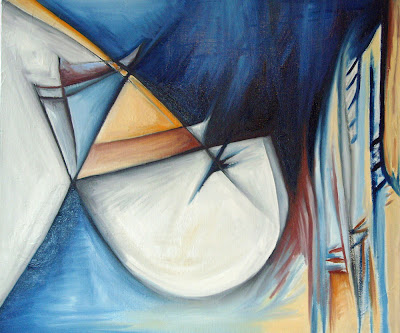
This new painting did not go as smoothly for me as the first one. (By the way, that first painting I have decided to name "Change is Inevitable" and it measures 30 x 36".) I used the same steps as on the earlier painting. First, I chose my sketch and taped it to the wall, where it is easily seen. Then, I did the drawing in black charcoal. The black charcoal lines were reiterated in oil paint. Again, the drawing is not about reproducing the sketch perfectly, but about finding the most balanced composition on the canvas. Right away, I ran into some issues, since the sketch is on a square piece of paper, but the canvas I used is much more rectangular. You can see how I started to stretch out shapes to activate more of the space.

It's hard to say where, exactly, this painting began to fall apart for me. I was having fun at the beginning, but looking at the photos, I can see that the composition is not solid because of the difference in shape between the sketch and the canvas. I did begin to add color, and advance the painting in much the same way as the first painting.
You can see that I am still turning the painting, as I usually do, to make sure I am working the whole surface of the canvas.

I still like the loose expressive qualities of the brushwork at this stage. I use very little medium when I paint, because I find that the medium is the smelly part, and my studio space has never been large or particularly well ventilated. So, necessitity is once more the mother of this style I have been using. I love the way thick paint looks anyway. Like frosting, with lots of texture. Yummy. The other thing I want you to notice at this stage is the part in the far left of the canvas. This will eventually become the crux of the whole painting for me.

I realized I had this space over in that area that somehow felt empty. You can see that I thought making some kind of visual texture might help it, so I used circular brushstrokes to fill in the blue area. That area began to irritate me, and even though I kept turning the painting, to work the whole canvas, that ONE section got the most attention.

One thing I did differently with this painting is that many of the shapes became closed within the edges of the canvas. The other painting had a lot more areas where one color melted into another, without the benefit of lines (or boundaries, as I sometimes think of them.) I continued to feel irritated, and ultimately ANGRY at that troublesome section on the left. (Now it's on the right side.)
I worked much longer and harder on this painting, at one point I even took it off the easel and walked it into the other room! I reworked a tiny painting to list on etsy, and completed two miniature paintings, the whole time obsessing over this big one. I finally caved, put it back on the easel, and worried it some more. The whole time I felt very dissatisfied.

Interestingly enough, This second painting, called "Winds of Change" is the one Matthias says he likes the best. I still like the first one better, but at least I don't hate this one as much as I did when I finally took it off the easel.

I have yet to decide if I will rework the "Winds of Change". I am feeling pretty good about the first one, but you never know. That one may get a facelift, as well.

Thursday, August 30, 2007

Process

I am finally painting again. It's hard to believe, but I broke down my studio last DECEMBER to pack, and this is the first chance I have had to set it up, and paint in oils once again. Time flies when you are moving to a completely new place. Anyway, I decided to try to share a little of my process with you, so you can see the evolution of an oil painting. Here we go.
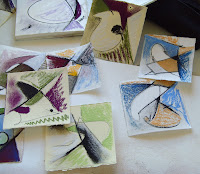
First, I sat down with my pastels, and some tiny pieces of paper I had torn up into these miniature squares. I stack them up next to me, take out the black charcoal pencil (number 4, if you really want to know), and do quick little drawings. It is important that the drawings are quick, because that's how I stay loose. I usually do between 6 and 9 of these little drawings. I line the drawings up where I can pick and choose, and then I begin to add color. This is where a lot of my experimenting comes in. It seems like the drawings usually get better as I go along, but of course nothing is set in stone. I try to get them all to a "complete" stage (these are only studies, after all, so I am not trying to finish them). Then, I choose a favorite. This will be the guide for the painting.
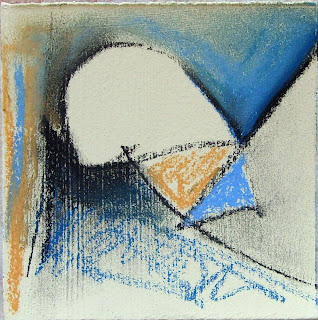
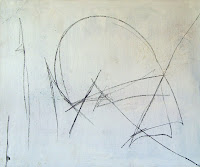
The canvas I used for this painting was already stretched and gessoed, ready to go. This saves a couple of days, for those of you who don't paint. I have this really black, messy charcoal that I use to do the preliminary drawing with. I am not worried about perfection here. The extra lines I draw to "find" the right proportions are lines that can be used, or not, later. This all depends on how I feel the composition is going as I get further along. Here you can see the charcoal drawing on my big canvas.
I have to admit, it was hard to remember to stop and take photos along the way! Harder than I thought it would be, that's for sure. I guess I was a little excited. I take my time, squeezing out the oil paints, and mixing colors. I have discovered that if I hurry here, the painting will suffer. I use this time to think about the relationship I want the colors to have, and to contemplate the feeling I am shooting for with the painting. I often have a word, or emotion in my mind when I start a painting. This one is really about the move, or more acurately, learning to bend with the wind. I am finding greater peace in bending whichever way I am being pushed (or led) by life.

I am always conscious of focusing on the dark and light areas. One of the things that I find exciting, visually, is having a big contrast between the dark and light areas of a painting. I like to start with the dark if I am working on a light ground, and start with the light, if the ground is dark. So the dark blue and black were painted first. I want the brushwork to have a lot of energy, so I am using big brushes, and rough brushstrokes initially.

At some point, I decided the colors were just not dynamic enough, so I began to add more color than I had initially planned on. I tend to turn the painting as I work, so that it forces me to work the whole painting at once. I want the painting to advance as a whole, rather than having one little area that I love, and the rest of the painting in shambles. I find turning the painting will help me with this. (Although it can be messy, since I usually paint the edges, too. That's just the price I pay, I guess.)

I have the little study for the painting taped up on the wall, right next to where I am working, so all I have to do is turn my head a little bit, and I can see it. With this in mind, remember that at some point, the large painting has to become its own work. There is always a departure from the original sketch, and sometimes letting go of that original idea is difficult.

I have now reached a point where if I were to continue working, the colors would get muddy looking. That is a sign that it is time to stop. (that, and my rumbling stomach!) So here is the painting in its last stage. There is a chance I may look at it tomorrow and find a section to rework. However, I need to let it dry before really working it again, if I want to keep the freshness. Since this is oil, it could take a week or two (or more!) for this to happen. So for now, I am done!